Alto
Introduction
Recently, a good friend of mine brought up the Alto1 high-speed rail (HSR) project. My initial reaction was very enthusiastic, but I hadn't grounded myself in many of the details. Since then I've been pondering and researching the project almost daily, while trying to get a feel for local and regional positions on the matter. My general impression toward Alto is one of high skepticism, at best, and public sentiment (which, admittedly, I've picked up on primarily from social media and reports around public consultations from Alto's representatives) isn't optimistic either. Between concerns about cost, environmental impact, land expropriation, urban-rural divides, corruption, and maybe some simple NIMBYism, there are a lot of different angles to consider from the "no" camp. I find myself with thoughts, which you're about to read (stop while you can).
The "Nots"
To be clear, I'm not against HSR as a concept. In fact, I think that serious and iterative commitment to building and improving public services - including infrastructure - is something that we are sorely missing as a society. A regional or even coast-to-coast HSR network is a transformative example of this, and it would dramatically alter the lives of nearly everyone across this land, often in unexpected ways. I find the lack of creativity in the public discourse about Alto very frustrating, but while I suspect that contrarianism plays a big part, it seems clear that there are valid concerns about it. So, this article is not:
- A dismissal of Alto's hypothetical benefits to those who would have access to it;
- A suggestion that the existence of opposition should stop further research and development toward such projects;
- Ignorance towards historically exploitative, dismissive, and otherwise one-way relationships between Canada and First Nations regarding land use, resource extraction, and treaty obligations, the trends of which this project will probably continue (even though it mentions consultations are ongoing);
- One of the usual arguments like "the country is simply too big", "it's too cold here for the trains to work", "it'd cost too much", and so on. These are solved problems in other parts of the world. We don't need to keep pretending we're on our own;
- A partisan position, i.e. opposition because the former PM and/or the team wearing red gets credit;
- Me pretending that I'm unbiased.
Let's get into it.
The Back of the Envelope
Ottawa to Toronto, for the Weekend (Round Trip)
Here come some numbers for an example trip, using these assumptions:
- The trip is assumed to begin on Friday, September 25th, 2026 (about six months from now). We're planning well in advance.
- Where possible, these numbers were obtained by searching for flights and trains via Google, using results for Westjet and VIA Rail, respectively. They do vary depending on time of year (and especially day of week - weekdays are sometimes $40-50 cheaper for a round trip), but you can find similar numbers by browsing the booking calendars.
- Fuel cost assumes there and back, plus some city driving, in a mid-sized SUV. It's probably closer to $200 at current per-litre costs.
- "Other Costs" is broad and meant to encompass everything from bus/subway fares to a one-off Uber ride, which can vary wildly in price. For the driver's case, it's also meant to cover parking. As of today, TTC fares2 are around $3.30 per ride for a single adult. There are lots of variables here, and those who've made similar trips before will likely attest to many mixed solutions they've come up with to save cash.
- The train and flight ticket prices are for a single adult - for a family, driving is by far the most affordable option.
- Time spent for the car assumes at least one short stop to stretch, use the washroom, etc., while for the flight it assumes you're at the airport at least an hour before departure. The train is simplest here.
| Item | Car | VIA Rail | HSR | Flight |
|---|---|---|---|---|
| Fuel Cost (CAD) | 150 | X | X | X |
| Ticket Cost (CAD) | X | 161 | ? | 493 |
| Other Costs (e.g. bus, subway, in CAD) | 100 | 50 | 50 | 50 |
| Time Spent (hours, one way) | 4.5 | 4.5 | 2 | 3 |
| Attention | Occupied | Free | Free | Free |
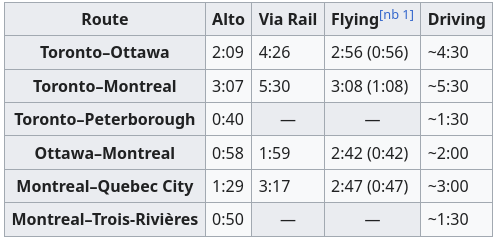
It goes without saying that all of these options are expensive for someone earning the median or average incomes (using 2023's numbers3) of $45,400 or $59,400 per year, respectively, so it's easy to understand how critics would perceive this project to be by and for a much wealthier demographic. I don't see any indication that Alto is expected to solve these problems of access and affordability. There are also hidden factors baked into those options to consider - for example, unless you use a carsharing service like Communauto, the first option means you need to own and maintain a vehicle, which is a frustrating and expensive barrier-to-entry for people to access many modes of living. When climate and environmental consequences are considered, all of them tend to look even worse (although Alto will be electric, which is a point in its favour). For comparison, here's the table4 from Wikipedia showing estimated times:
What Will an Alto Fare Cost?
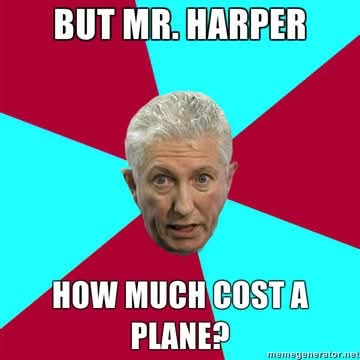
I think that this is the single most important question to be asked about this project: once all of the sacrifices are made despite myriad objections, will anyone actually be able (or want) to use it? This reminds me of another question which former BQ leader Gilles Duceppe once rightly asked, long ago:
For Alto, the best place to start looking may be a recent study5 published by McGill in late 2025 (updated 2026), which my aforementioned friend pointed out. Notably, it is based on a survey which (after a data validation step) only includes 8,276 responses, all of whom are distributed among the cities with proposed stops - so, excluding the many communities along the route but without direct access, along with everybody further afield in other regions of the country. This seems fine for estimating ridership, station preference, and so on, but not other categories such as perceived benefits or concerns.
The most interesting analysis there is the "Willingness to Pay" section, which suggests that prospective riders would only be willing to pay about $25 more per fare than for VIA Rail. Using our single-adult hypothetical from earlier, that'd mean the round-trip cost for Alto would be $186. That doesn't sound too bad, especially when you compare it to the flight.
Two problems:
- Most people are going to compare costs, see that the train is more expensive, and choose to drive anyway - especially when the apparent flexibility of driving versus being bound to train and public transit schedules is considered (and despite potential parking fees);
- VIA Rail services seem unlikely to remain viable once Alto is complete - their 2023 annual report6 mentions that 96% of passenger trips were taken along the Quebec City-Windsor corridor - unless there's a major re-imagining of their mandate.
To reiterate, all of this is also assuming a single adult is making the trip - the argument falls apart pretty quickly with access to "cheap" fuel and a vehicle if you are going with friends and/or family. Will this be the case in 20 years when Alto is up and running? It's hard to say, but for now other forms of transportation are really expensive. Unless costs come down across the board, I don't see how Alto is going to be any more appealing than the decision to drive, even if it means taking 2.5 times as long (or more, with rush hour traffic).
Which Problem Are We Solving?
If we want to see serious adoption of public transit from a majority of the population, then the real issue is that these services are already too expensive for most riders. I'm not quite as concerned about Alto's engineering aspects or the price tag - we can get ideas of what to expect from other countries who've worked on megaprojects before. To be fair, this is already happening - Cadence7 (the organization slated to build Alto) includes SNCF Voyageurs and Keolis on the international side, and a post8 from the Japanese Embassy about hosting an Alto round table seems like further (if anecdotal) evidence of that. I'm not sure that speed is the actual priority, though. What's missing is a plan to push ticket prices down, and to increase reliability of alternatives to driving.

I still want to look into other studies on this, but in my mind the threshold for choosing to ride the train every time as a family of four - assuming that something like VIA's policy9 of children traveling for free is in effect for the trip, so only two adult tickets are required - comes in at about $200, or about 33% more than the driving estimate. This per-adult cost of about $100 is where I'd have to seriously consider leaving the car at home, keeping in mind that there's still a lot of other factors which make this kind of outing a fairly rare one. I'm assuming that people thinking about such a trip have the funds to allow those choices, though. To make it accessible to more people, it should be pushed much lower, with corresponding investments in higher reliability and more frequent service. Apparently there was a report10 suggesting a similar model in 2015, at least on the expansion-of-service side.
Speaking of VIA Rail again, their 2023 report listed operating expenses of $812.5 million and operating losses of $381.8 million, respectively. With ~40 million people, those operating expenses work out to a little over $20 per person per year, with current fare costs. You have to wonder what a version of the VIA Rail service running at two, three, or even five times that number would look like, assuming the difference was split between expanded service and subsidizing of the fares themselves. The main issue that comes to mind with the expansion aspect is increased emissions and further reliance on one type of energy (diesel). Maybe there's an approach where slower electrified services are easier to build? This would require a lot of the same safety measures that Alto HSR would to deliver power to the trains (so the tracks would still be fenced and impassable without going over or under), but removing the wide turning radius required for high-speed operation may make it easier to avoid routing through critical habitats and properties whose owners are opposed to the current proposals. If such examples don't exist yet, then maybe this is a chance for us to show the rest of the world a new example.
Ultimately, I think that public services should not be expected to turn a profit, and if spending a little more means coming up with a solution that addresses this line of thinking, it may be the best path forward.
Future Work
International Studies and Other Media
A non-exhaustive list of papers which I've either read, or plan to read, around HSR projects elsewhere in the world:
- High Speed Rail Performance in France: From Appraisal Methodologies to Ex-post Evaluation
- The impacts of high-speed rail expansion on short-haul air passenger transport - Evidence from German domestic and international traffic
- Spatial equity and high speed trains: the example of France
- Smart and Affordable Rail Services in the EU: a socio-economic and environmental study for High-Speed in 2030 and 2050
- The Development of High-Speed Rail in the Federal Republic of Germany Between 2002-2020
I'll have to find and read publications around African proposals, along with Chinese and Japanese systems, too. If video essays are more your thing, there are at least eight focused on train infrastructure on the Wendover Productions channel11 (I can't recall which ones I've seen).
Trains of Thought
Some related topics, which I may explore in the future:
- Degrowth and slowing down - how is our perception of trip length changed if our society finds ways to reduce the urgency with which we work and travel? I suspect these ideas quickly intersect with problems of compressed or reduced work weeks, remote work options, universal basic income (UBI) projects, and other concepts meant to alleviate pressure on people to always be producing, achieving, and doing.
- Necropolitics and ecological borderization - what do fare costs, geographic accessibility, and environmental consequences look like when infrastructure projects are viewed as physical and economic borders? How do we ensure equity across the population? What does it mean not only for the ecological systems we are part of, but our changing relationships with our non-human kin?
Last Words
In the week or so since I began writing this post, it feels like the activity around the Alto project on social media has grown (although with algorithmic feedback loops and the potential for fake accounts, it's hard for me to know how much without digging). I'm having a hard time keeping track of the many articles, letters written to Parliament, and research papers on successes and failures in other HSR projects around the world. There's even been a press conference12 from the leader of the federal opposition, with very predictable content - a firm "no" to Alto, lamentation about no "projects" (pipelines) being built, and so on - which really seemed like a combination of points from The Nots.
I am not an expert on the inner workings of federal government, so I can't be sure of the presser's political expediency. However, given that it seems like more of the same rhetoric used in recent elections, I'd guess one of three outcomes, in order of likelihood:
- It is seen as opportunistic positioning and/or a continuation of favouring rural areas at the expense of urban ones - despite the CPC losing the interest of those ridings in the near term - and is largely ignored;
- It motivates the LPC to push the Alto project even harder to avoid a loss of confidence and a sudden election (although recent floor crossings13 suggest that maybe this isn't a problem);
- Two or more parties revisit the project and the budget, then consider possible alternatives for rail expansion alongside other big projects to shore up ailing industries and economic hardship.
It's truly unfortunate that we're perpetually stuck in the middle of this back-and-forth dance. Maybe if plans to implement proportional representation in our electoral system (which, coincidentally, were promised and then cancelled by former PM Trudeau, who also happens to have announced14 the Alto project shortly before his retirement) hadn't been cancelled, we could have more transparency than it seems we're getting. It might also mean more creative approaches to solving the growing transportation challenges that people face every day.
Special Thanks To
-
Justin for:
- Inspiring this dive in the first place
- Sharing your insights and concerns, particularly around the McGill paper
- Reviewing my drafts, and always being willing to chat
-
Amy for:
- Listening to me rant, at any time of day
-
Mitch for:
- A very relevant Gilles Duceppe meme
References
Alto (2026). Alto: Shaping Canada's Future With a High-Speed Train. https://www.altotrain.ca/en
Toronto Transit Commission (2026, April 02). Information about TTC fares and passes. https://www.ttc.ca/Fares-and-passes
Statistics Canada (2025, May 01). Income of individuals by age group, sex and income source, Canada, provinces and selected census metropolitan areas. https://www150.statcan.gc.ca/t1/tbl1/en/tv.action?pid=1110023901
Alto (high-speed rail) (2026, April 04). In Wikipedia. https://en.wikipedia.org/w/index.php?title=Alto_(high-speed_rail)&oldid=1346827990
Billie Zhang, Hisham Negm, & Ahmed El-Geneidy (2025). High-Speed Rail in Canada: Insights from a corridorwide survey & a financial analysis. https://tram.mcgill.ca/Research/Surveys/HSR_REPORT_2026.pdf
VIA Rail (2024, March 21). 2023 ANNUAL REPORT. VIA Rail Canada. https://media.viarail.ca/sites/default/files/publications/397_034_VIARAIL_ANNUAL-REPORT-2023.pdf
Cadence (2025). About us. Cadence. https://cadence.info/en/about-us
The Embassy of Japan in Canada [@japan_embassy_canada] (2026). Can Japan contribute to high speed rail in Canada? We welcome your comments [Photograph]. Instagram. https://www.instagram.com/p/DWcbL0BDZr1
VIA Rail (2026). Canada Strong Pass. VIA Rail Canada. https://www.viarail.ca/en/offers/canada-strong-pass
Jean Dupuis (2015, August 31). VIA Rail Canada Inc. and the Future of Passenger Rail in Canada. Parliamentary Information and Research Service. https://lop.parl.ca/staticfiles/PublicWebsite/Home/ResearchPublications/BackgroundPapers/PDF/2015-55-e.pdf
Wendover Productions. Videos [YouTube Channel]. Retrieved April 04, 2026, from https://www.youtube.com/@Wendoverproductions/videos
CBC News. (2026, March 31). Poilievre holds news conference in Peterborough, Ont. [Video]. YouTube. https://www.youtube.com/watch?v=gE6J9kReZic
Murphy, J, Yousif, N. (2026, March 11). Carney inches closer to majority, as fourth MP defects to Liberals. BBC News. https://www.bbc.com/news/articles/c0e5jwz0703o
Prime Minister of Canada (2025, February 19). Canada is getting high-speed rail. Government of Canada. https://www.pm.gc.ca/en/news/news-releases/2025/02/19/canada-getting-high-speed